
From Single-Part Success to Stable Mass Production: Diamond Tool Vacuum Brazing Depends on Process Engineering
True production capability means processing more workpieces per cycle while maintaining consistent interface quality, tool life, and process traceability across every batch.
In diamond tool manufacturing, vacuum brazing is no longer simply an alternative to torch brazing or induction brazing. For PCD, CVD, MCD, CBN, PCBN, natural diamond, and carbide tools, it has become a key process for bringing high-performance tools into stable mass production.
A tool that looks excellent in a trial run does not automatically guarantee that every batch will perform the same way. As loading quantity increases, insert size becomes larger, material combinations become more complex, and more operators are involved, small process variables can be amplified. Insert positioning, paste application, bond line thickness, thermal profile, interfacial reaction, and cooling stress can all influence the final quality, tool life, and production stability.
For modern diamond tool manufacturers, the real requirement is not a single equipment specification. It is a process engineering system that can be repeated, managed, and verified.
This is the foundation of Pin Power’s approach to vacuum brazing. True mass-production capability is not only about loading more workpieces per cycle. It is about maintaining consistent interface quality, stable bonding strength, predictable tool life, and complete process traceability under high-loading production conditions.
High Loading Capacity Creates Efficiency, but Consistent Quality Defines Real Productivity
For production facilities, high loading capacity is essential. It directly affects lead time, cost per tool, equipment utilization, and production scheduling flexibility. When a vacuum brazing system can process more tools in one cycle, manufacturers can respond to customer orders more efficiently, reduce waiting time, and increase total output.
At Pin Power, we believe high productivity is a basic requirement for industrial vacuum brazing.
But in diamond tool manufacturing, capacity cannot be measured only by how many workpieces can be loaded. The more important question is whether each tool can still receive stable thermal exposure, stable brazing alloy behavior, controlled interfacial reaction, and reliable post-brazing quality when more workpieces are processed in one cycle.
If some inserts in the same batch are well positioned while others are slightly displaced; if some bond lines are flat while others show local buildup; if some interfaces are fully filled while others contain micro-gaps, high loading capacity cannot become true productivity.
Pin Power’s goal is not to choose between capacity and quality. It is to achieve both: more workpieces per cycle, with consistent and verifiable quality across every batch. Capacity creates efficiency. Consistency turns efficiency into real production value.
Production Instability Often Comes from Three Process Variables
In diamond tool brazing, many problems do not appear immediately after brazing. A tool may look acceptable after the furnace cycle, but issues may only become visible during grinding, inspection, or actual machining at the customer site.
These issues may include insert-height variation, uneven bond lines, micro-voids, incomplete wetting, insert displacement, brittle interfacial layers, or tip loss under heavy cutting loads.
Behind these failures, the cause is rarely a single factor. It is usually the interaction of several process variables.
The first is thermal stress control. Diamond materials, steel, tungsten carbide, and other substrates have different coefficients of thermal expansion. During cooling, these materials contract differently, creating stress at the brazed interface. If the heating, holding, and cooling profile is not designed for the material combination and tool geometry, residual stress, micro-cracking, or long-term tool-life variation may occur.
The second is brazing alloy behavior control. Brazing paste is not just a filler material. Its application behavior, tackiness, flowability, melting behavior, wetting ability, and final bond line morphology all affect insert positioning, interface filling, bond line flatness, and post-processing stability.
The third is interfacial reaction control. In active brazing, the brazing alloy reacts chemically with diamond, steel, carbide, or other substrates. When properly controlled, this reaction creates a reliable bond. If excessive or uneven, it may form brittle phases or weak interfaces that reduce durability under real cutting conditions.
In other words, vacuum brazing is not simply about heating materials to the correct temperature. It is about ensuring that materials join at the right time, in the right place, and in the right way. That is the essence of process engineering.
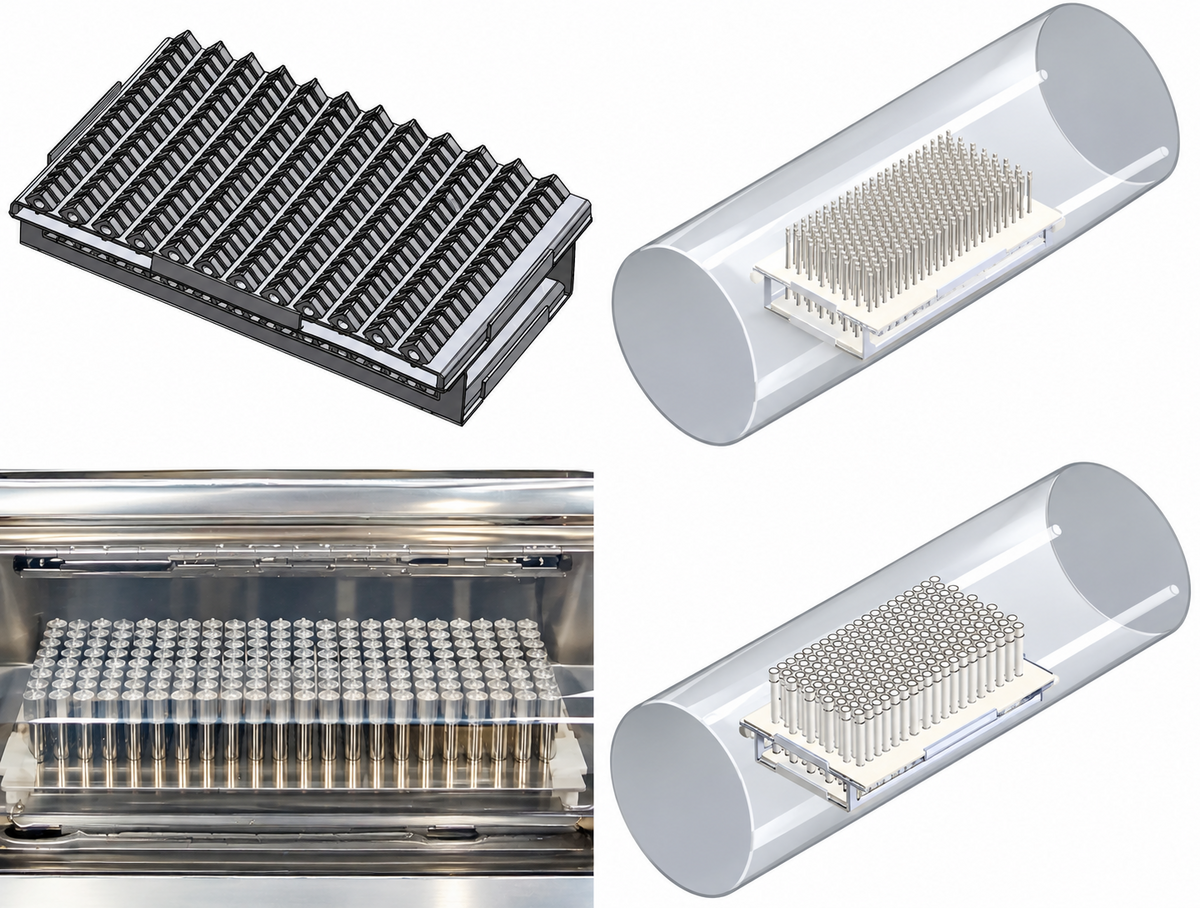
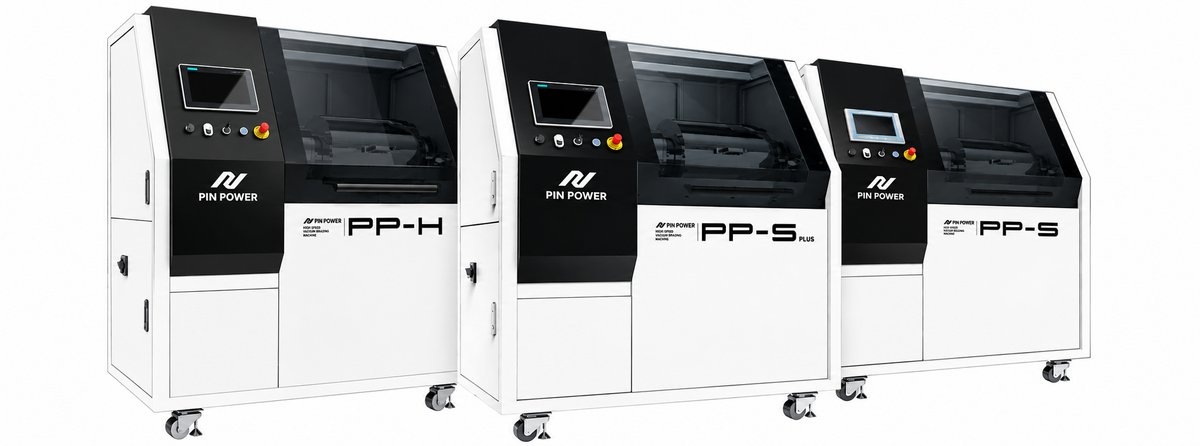
Pin Power fixture loading schematic: Up to 326 pcs per batch for PP-H and 195 pcs for PP-S Series.
Smart Batch Production Is Not Simply Mixing Different Tools in One Cycle
When manufacturers want to increase efficiency, placing different tools in the same brazing cycle may appear to be the most direct way to raise output.
However, smart batch production is not simply mixing different tools together. It requires engineering-based grouping according to material family, insert size, substrate thermal mass, tool geometry, brazing paste characteristics, and interfacial reaction windows.
Large PCD inserts, CVD diamond tools, heavy steel-bodied tools, and micro-precision tools may respond very differently to the same thermal profile. Their heat absorption, cooling behavior, thermal expansion mismatch, alloy flow requirements, and positioning needs must all be evaluated carefully.
This is why Pin Power’s production logic is not to simply fill the chamber as much as possible. Based on high loading capability, the process must combine the correct batch strategy, thermal recipe, fixture design, and brazing paste selection so that every tool receives the conditions it requires.
Mass production is not only about increasing quantity. It is about enabling more tools to succeed consistently under the same process logic.
Brazing Paste Is Not Just a Consumable. It Is an Engineering Variable
In vacuum brazing, equipment performance matters. Vacuum capability, heating efficiency, temperature control, and chamber design all support process stability. But for diamond tools, another factor is equally critical: the brazing paste.
Brazing paste directly affects insert positioning, alloy distribution, melting behavior, interface wetting, bond line thickness, joint flatness, and final bonding strength. It should not be treated merely as a consumable. It is a key engineering variable within the brazing process.
Pin Power’s PPBA series active brazing paste is based on a pre-alloy material concept. Unlike conventional blended pastes, which are produced by mechanically mixing different metal powders, pre-alloy powder is formed after the alloying elements have already been metallurgically integrated.
This material design supports more consistent composition, more stable reaction behavior, and more predictable flow during melting. For mass production, this means the brazing alloy behavior is easier to standardize and more repeatable from batch to batch.
In high-performance diamond tool manufacturing, success is not a good furnace run. Success is stable results across every production batch. The value of pre-alloy brazing paste is that it reduces material-related variation and makes process control more reliable.
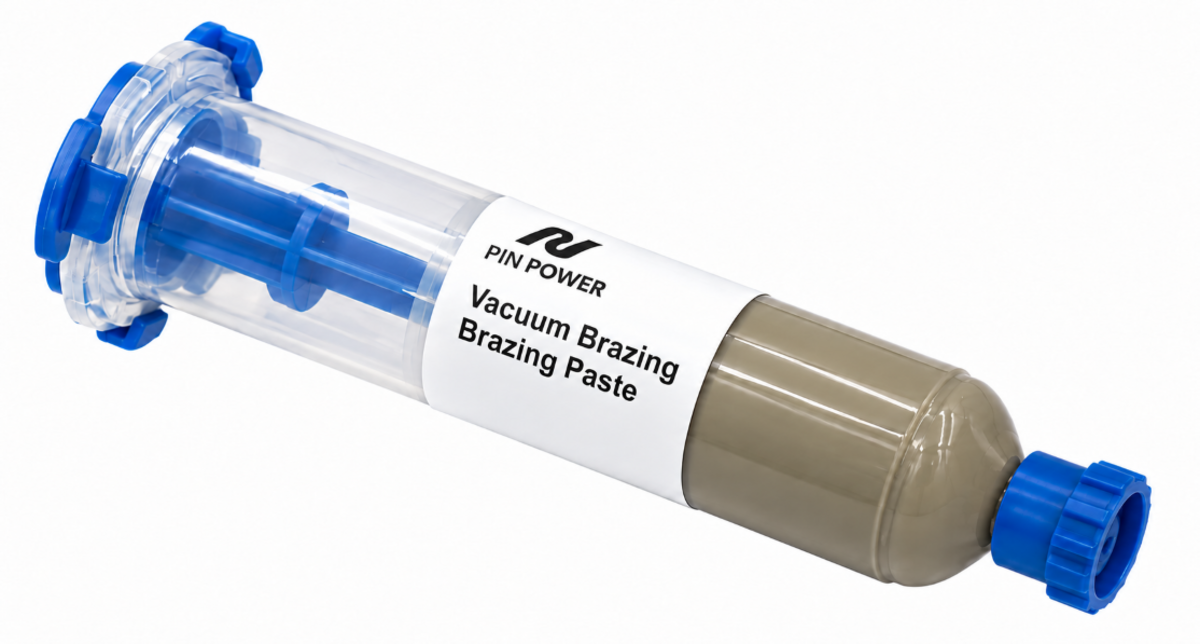
PPBA-65 Active Brazing Paste
High Tackiness and Bond-Line Consistency Improve Both Handling and Quality
In production, seemingly simple handling details can directly affect final quality.
When brazing large PCD inserts, carbide inserts, or heavier cutting tips, positioning stability becomes critical. During paste application, insert placement, workpiece transfer, pre-drying, and loading before brazing, insufficient tackiness can allow the insert to slide or shift.
These movements may be small at first, but after brazing they can lead to uneven alloy distribution, inconsistent bond-line appearance, insert-height deviation, and additional grinding or correction work.
For this reason, paste tackiness is not merely an operator convenience. It is a process factor that helps reduce human variation and improve batch consistency.
Pin Power’s PPBA brazing paste features excellent Super Sticky tackiness. For large PCD inserts, carbide inserts, or tools with more complex geometries, this high tackiness helps the insert remain stable after placement, reducing sliding and displacement during preparation and supporting more consistent positioning before pre-drying and furnace loading.
Bond line consistency is another critical but often underestimated quality factor in diamond tool mass production.
If the brazing layer is locally too thick, too thin, or uneven, post-brazing grinding and inspection become more difficult. Operators may need to spend more time correcting insert height or bond-line appearance, and local variation may affect tool accuracy and batch consistency.
Pin Power’s PPBA pre-alloy active brazing paste supports stable application, melting, and flow behavior, helping form a more uniform, flatter, and more repeatable brazing layer. This is not simply about better appearance. It is about making post-brazing dimensions more controllable, grinding more stable, and batch quality easier to manage.
For operators, stable insert positioning means smoother handling and fewer adjustments. For manufacturers, a consistent bond line means less rework, better batch stability, and more predictable post-processing.
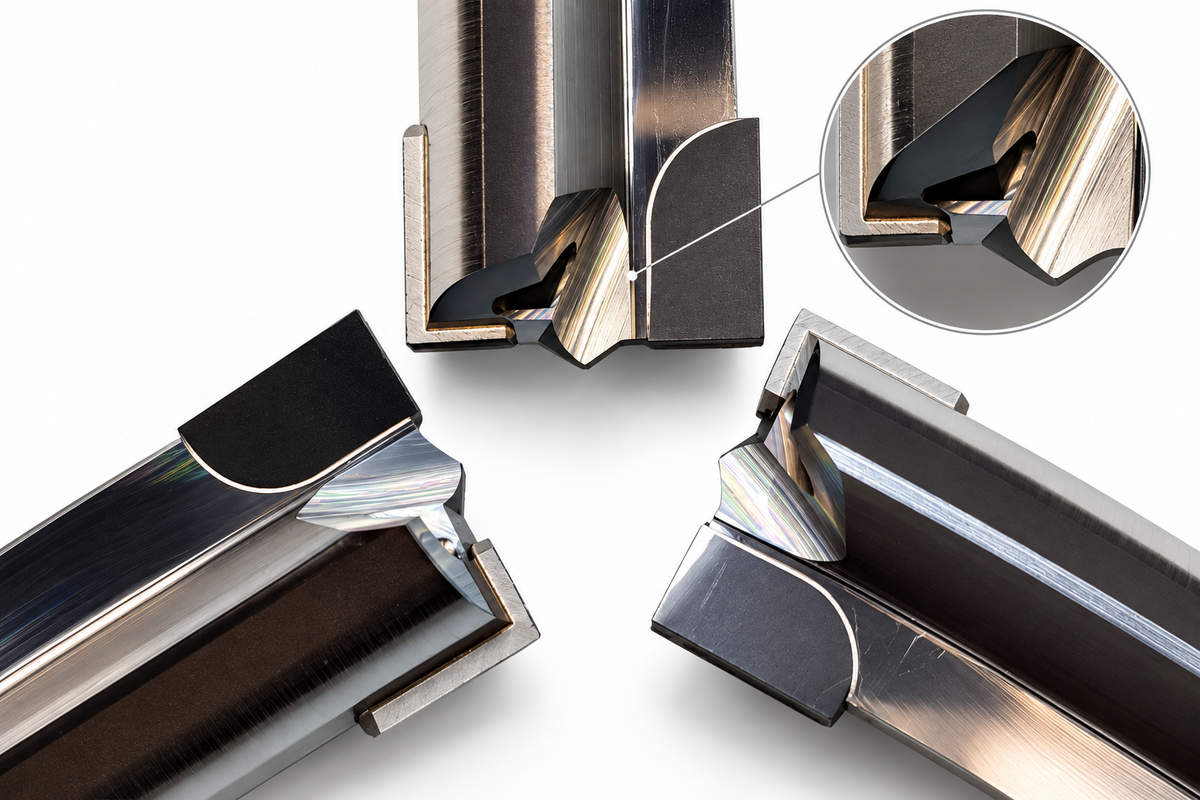
Ensuring Pristine Diamond Surfaces with Quality and Consistency.
Interface Integrity Ultimately Determines Tool Life at the Customer Site
Brazing quality is not ultimately verified by an equipment specification sheet. It is verified in the customer’s machining environment.
When machining CFRP, titanium alloys, aluminum alloys, ceramics, SiC, or other abrasive materials, diamond tools must withstand cutting forces, thermal cycling, vibration, and long operating hours. Under these conditions, the true support of the cutting edge is not only its external geometry, but the brazed interface beneath it.
If the interface contains voids, gaps, incomplete wetting, or brittle reaction layers, the tool may fail prematurely under heavy loads. For end users, tip loss is not simply a damaged tool. It can mean machine downtime, scrapped workpieces, and production loss.
This is why Pin Power has long emphasized interface integrity.
Stable interface quality is not achieved by the furnace, paste, or operator alone. It is the combined result of thermal profile control, material behavior, fixture design, insert positioning, reaction management, and standardized workflow.
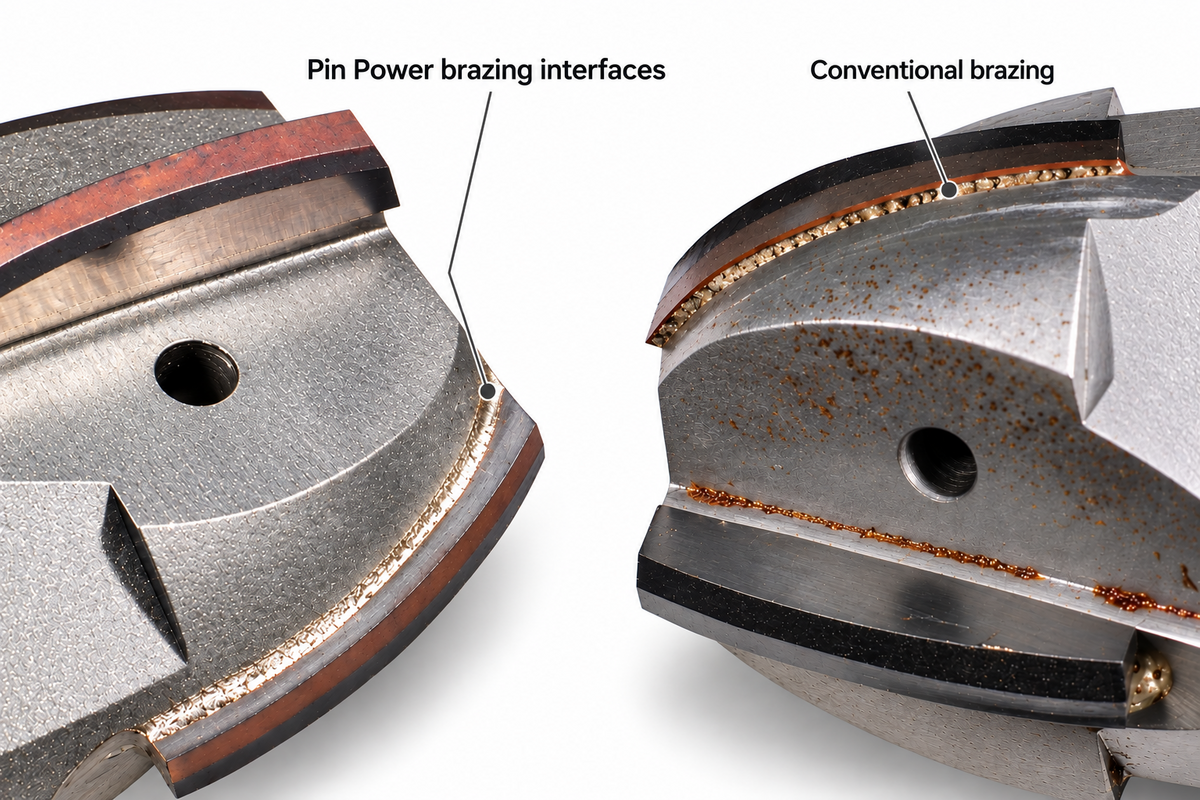
Comparison of Brazing Interfaces
Turning Expert Know-How into Repeatable and Traceable Process Parameters
Many diamond tool manufacturers have traditionally relied on experienced brazing technicians. These specialists judge brazing conditions through flame color, heating time, manual feel, and years of accumulated experience.
In today’s manufacturing environment, this model is becoming harder to scale. Skilled technicians are difficult to recruit. Experience is difficult to transfer. Overseas production sites require standardized workflows. Customers increasingly demand quality traceability and process consistency.
Modern vacuum brazing should therefore not depend solely on individual operator experience. Know-how must be transformed into manageable, repeatable, and traceable process parameters.
Pin Power’s system design is built to turn complex brazing engineering into an executable standard process. Through an intuitive user interface, recipe management, guided workflow, and one-click operation, new operators can learn stable production procedures more quickly, reducing human error and training barriers.
For advanced production needs, remote access, data logging, energy management, temperature discrepancy alerts, and cooling system monitoring help factories reduce downtime risk, improve quality traceability, and manage overall equipment efficiency and production cost more effectively.
In high-end diamond tool mass production, stable quality should not depend on one highly skilled operator. It should come from a repeatable and stable system.
A New Standard for Mass-Production Diamond Tool Vacuum Brazing
As the diamond tool market continues to move toward higher precision, longer tool life, higher efficiency, and traceable manufacturing, the role of vacuum brazing equipment is changing.
"The system is no longer just a heating machine; it has evolved into a high-productivity platform, a precise material control system, and a foundation for consistent quality and process traceability."
For diamond tool manufacturers, the real objective is not to compromise between capacity and quality. It is to achieve both.
True mass-production capability means processing more workpieces per cycle while controlling insert positioning, bond line consistency, interfacial reaction, thermal stress, and process data across every batch.
This is the process engineering standard that Pin Power is built around. By integrating a high-productivity vacuum brazing platform, precise thermal profile control, pre-alloy PPBA active brazing paste, Super Sticky positioning support, stable bond line control, fixture design, interfacial reaction management, intuitive operation, and traceable process data, Pin Power helps diamond tool manufacturers build a more stable, safer, and more scalable vacuum brazing process.
In diamond tool manufacturing, real competitiveness is not defined by one equipment specification. It is defined by the ability to transform material behavior, interfacial reaction, and operator experience into a repeatable mass-production process.
Source |Pin Power Co., Ltd.