![[Translate to English:] InDiamond.world](/fileadmin/_processed_/a/1/csm_InDiamond_Logo_2021_1fb017de30.png)
Artificial intelligence for small and medium-sized enterprises: WZL research project AKIMI brings agent-based AI to robotic assembly
RWTH Aachen University’s WZL launches initiative for intuitive programming and flexible reconfiguration of robot systems in SMEs
How can robotics be made flexible enough for small and medium-sized enterprises (SMEs) so that it can be used intuitively without in-depth specialist knowledge? With this key question in mind, the new research project “AKIMI” (Agent-based AI for intuitively reconfigurable robotics in SMEs) was launched on 2 July 2026 with a kick-off meeting. During the kick-off meeting at the Chair of Information, Quality and Sensor Systems in Production at the WZL Machine Tool Laboratory of RWTH Aachen University, the course was set for practical development in collaboration with the Institute for Business Cybernetics (IfU) e.V. and a broad-based industrial committee.
Small and medium-sized enterprises are increasingly faced with the challenge, in production and logistics, of having to respond to volatile markets, declining batch sizes and the ongoing shortage of skilled workers. In this environment, automation solutions and traditional robotic systems often fail due to high programming costs and rigid system architectures. This is precisely where the AKIMI project consortium comes in: the aim is to develop a hybrid, agent-based artificial intelligence (AI) system that radically simplifies the set-up, programming and reconfiguration of robotic systems.
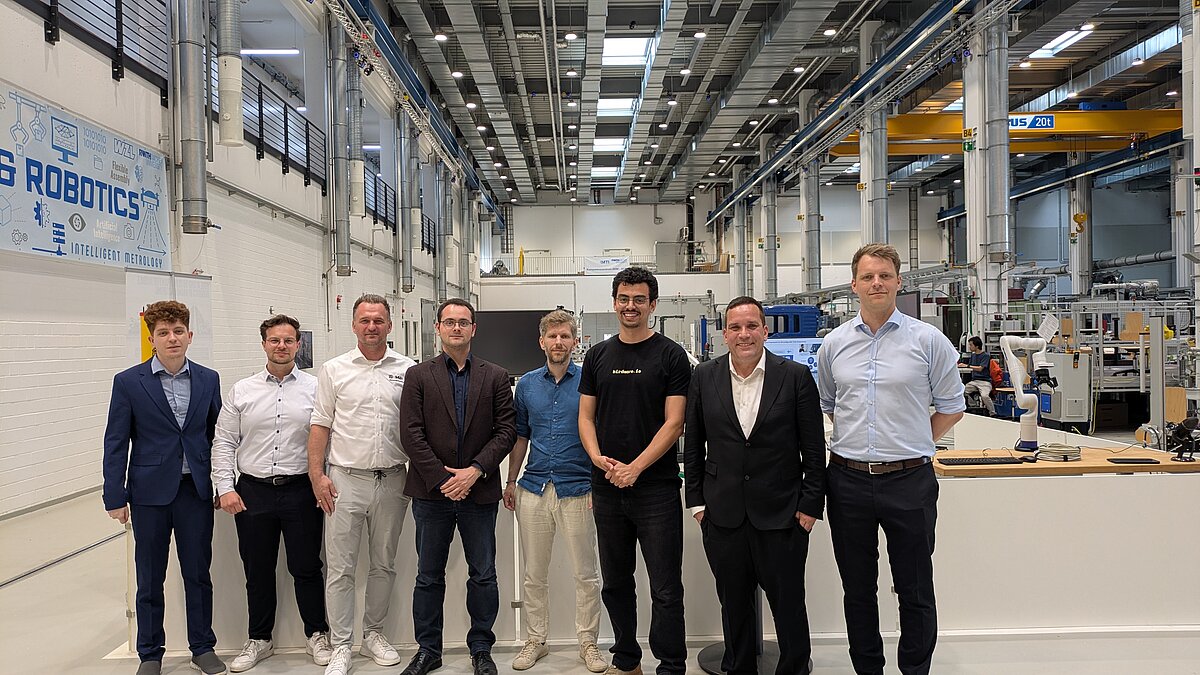
Launch of the “AKIMI” research project (Agent-based AI for intuitively reconfigurable robotics in small and medium-sized enterprises)
Hybrid agent-based AI: A bridge between language models and physical implementation
At the heart of the project lies the approach of combining state-of-the-art language models – known as Large Language Models (LLMs) – with structured knowledge and proven basic robotic functions. Unlike purely text-based AI systems, ‘agent-based’ AI acts proactively, independently breaking down complex human instructions into logical sub-steps and controlling robot kinematics in a targeted manner. As a result, complex tasks in assembly and logistics are, for the first time, made accessible via intuitive interfaces – such as natural language – even to staff without programming skills. A particular technological focus is placed on ensuring transparency, traceability and reliability. As AI decisions in an industrial environment must be deterministic and absolutely safe, the AKIMI system continuously checks proposed action sequences against the laws of physics and predefined safety restrictions.
‘Sense – Think – Act’ in intelligent assembly automation
At the WZL Machine Tool Laboratory of RWTH Aachen University, the research project is being carried out at the Chair of Information, Quality and Sensor Systems in Production (WZL-IQS) under the leadership of Prof. Dr.-Ing. Robert Schmitt. The WZL is contributing its in-depth expertise in intelligent assembly automation as well as its tried-and-tested institutional guiding principle of “Sense – Think – Act”. The Aachen-based researchers are primarily focused on seamlessly linking the interfaces between sensory perception (Sense), AI-supported decision-making (Think) and precise robotic execution (Act). To ensure maximum practical relevance, the theoretical models and software architectures will be validated in realistic demonstrators as the project progresses and directly applied to specific use cases provided by the industrial partners.
“Small and medium-sized enterprises need flexible automation solutions that can be adapted without in-depth programming knowledge. With AKIMI, we are drastically lowering the barriers to the use of robotics: the agent-based AI acts as an intelligent assistant that translates complex tasks into understandable steps.” – Prof. Dr.-Ing. Robert Schmitt, holder of the Chair of Information, Quality and Sensor Systems in Production (IQS) at the WZL of RWTH Aachen University
Strong roots in industrial practice
The successful launch of the project underscores the high level of market interest: numerous renowned companies and institutions are supporting the project as part of the project steering committee and, at the kick-off meeting, ensured an intensive, continuous flow of requirements drawn from real-world industrial practice. The committed partners include, amongst others:
|
|
|
|
|
|
|
|
|
|
|
|
|
|
Funding
The AKIMI research project is funded by the Federal Ministry for Economic Affairs and Climate Action (BMWK) as part of the Joint Industrial Research (IGF) programme, following a resolution by the German Bundestag. The project participants would like to express their gratitude for the support and the provision of research funding.
Source | WZL