![[Translate to English:] InDiamond.world](/fileadmin/_processed_/a/1/csm_InDiamond_Logo_2021_1fb017de30.png)
A pinch of chromium improves the performance of diamond grinding wheels.
The production of carbide drills and milling cutters imposes high demands on the grinding wheels used in this process. Low wear and minimal process temperatures are required to prevent thermal damage to the manufactured tools. In this context, diamond cutting grains are utilized. These grains are not only integrally embedded into the copper-based grinding wheel bond but also form a cohesive bond with it. Since copper and diamond do not react chemically with each other, the diamonds can be pre-coated with carbide formers to initiate a reaction during the sintering process.
The DFG project "Performance of Sintered Metallic Diamond Grinding Wheels with Chemically Bonded Abrasive Grains," conducted at the Institute of Production Engineering and Machine Tools (IFW), investigated whether a cohesive bond could be achieved without prior coating. The bonding was to be achieved solely by adding chromium powder to the grinding wheel bond.
The investigations show that even a small addition of 2 wt.% chromium can achieve complete encapsulation of the diamonds with chromium carbide. A sintering temperature above 750°C and the smallest possible particle sizes of chromium are crucial. The higher specific surface area of smaller particle sizes increases the likelihood of chromium particles coming into contact with the diamonds, thus promoting carbide formation.
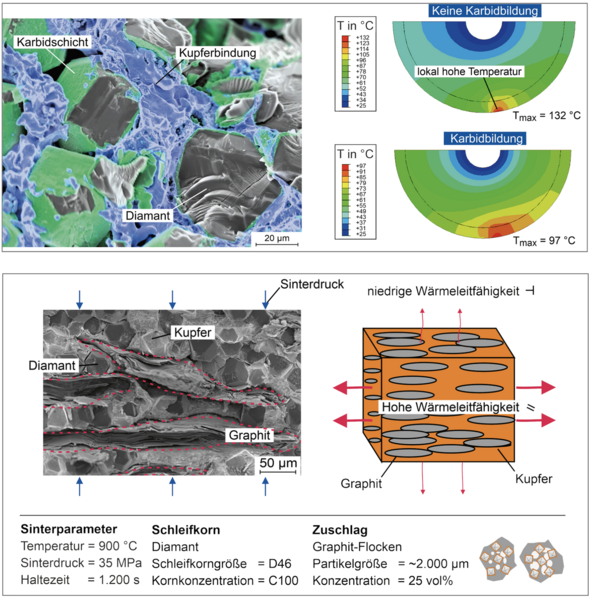
Compared to purely cohesive bonding, the mechanical strength of the grinding layer was increased by 363% due to the improved bonding of the diamonds. Performance tests in deep groove grinding of carbide showed a significant reduction in wear and lower grinding forces due to the stronger grain retention forces resulting from carbide formation. The carbide formation additionally enhances the heat transfer between the bond and the diamonds, leading to an increase in the thermal conductivity of the grinding layer by up to 102% compared to cohesive bonding. The increased thermal conductivity improves the dissipation of heat from the contact zone between the grinding wheel and the carbide workpiece, thus preventing the formation of welds on the carbide.
The more uniform distribution of heat within the grinding layer, rather than localized at the tool-workpiece contact, leads to more efficient process cooling. This was confirmed both in an FEM simulation and through temperature measurements in the workpiece and the grinding wheel. In accordance with the FEM simulation, it was shown that the improved thermal conductivity leads to a 17% decrease in the normalized contact zone temperature. The resulting residual stresses also show reduced thermal stress on the workpiece, with compressive residual stresses increasing by 18% when using the grinding wheel with a 2 wt.% chromium content, compared to using the wheel without carbide formation.
A continuation of the project is planned for 2024 within the framework of the DFG project "Performance of Sintered Metallic Diamond Grinding Wheels with Graphite Addition." The insights already gained will be utilized, and the addition of graphite is expected to further improve the thermal conductivity and particularly the dressability of metallic bonded grinding wheels. Preliminary investigations have shown that the targeted addition of graphite can weaken the bond, resulting in improved self-sharpening during the grinding process. The use of flake-shaped graphite for manufacturing the grinding layers causes the graphite flakes to align perpendicularly to the applied pressure during the sintering process. In these grinding wheels, there is an increase in thermal conductivity in the radial direction.
The previous project already demonstrated that increased thermal conductivity leads to improved performance, accompanied by lower temperatures at the tool-workpiece contact. In addition to the macroscopic assessment of performance, this project will also investigate the microscopic level. For this purpose, single-grain samples with the respective bonding systems will be produced and used in the kinematics of longitudinal scratching. These investigations provide insights into the dynamic performance of a single grain in relation to the surrounding bond and serve to describe the interaction and wear mechanisms when grinding with complete grinding wheels. The overall goal of this project is to develop a load-specific model for designing metallic bonded diamond grinding wheels for machining carbide. The project aims to close the knowledge gap regarding the relationships between the addition of graphite and chromium to the bond matrix, the resulting grinding layer properties, and the performance of sintered metallic diamond grinding wheels.
Source: FW Hannover