![[Translate to English:] InDiamond.world](/fileadmin/_processed_/a/1/csm_InDiamond_Logo_2021_1fb017de30.png)
ISBE: A trusted partner for digital tool manufacturing
The demands placed on tool manufacturing companies have become significantly more stringent in recent years. An increasing variety of product variants, smaller batch sizes, a high burden of documentation and a growing shortage of skilled workers are compounded by highly automated machinery and mounting cost pressures. At the same time, there is a growing need to make processes transparent, stable and reproducible – without compromising the necessary flexibility of production.

Digital tool data from ISBE
In this challenging environment, ISBE GmbH has been supporting tool manufacturers for many years as a reliable partner. Its mission is clearly defined: to create software solutions that reflect industrial reality. ISBE combines a deep understanding of tool manufacturing processes with modern software architecture, deliberately stepping in where standard systems reach their limits.
Proximity to manufacturing as a guiding principle
ISBE’s solutions are born out of practical experience. They are based on real-world processes across the entire value chain – from order placement through production to quality assurance. The aim is to make complexity manageable without simplifying it. Variants, special processes and company-specific rules are not bypassed, but rather structured and represented transparently.
Instead of isolated IT tools, ISBE provides flexible software solutions that effectively complement existing tool grinding machines, measurement systems and ERP solutions. This creates a seamless data process that supports operational teams.
Products with technical added value for tool manufacturing
At the heart of ISBE’s solutions lies not traditional process tracking, but the structured provision and utilisation of manufacturing data for cutting tools throughout the entire value chain. The aim is to consistently map technical requirements from the tool user through to manufacturing and quality assurance, and to make them usable.
The starting point is the end customer’s requirements: geometries, tolerances, operating conditions or criteria relevant to tool life. This information is processed, for example, in ISBE TD Sketcher in such a way that it serves as a reliable basis for tool design. Manufacturing and quality thus work on a shared, clearly defined data basis – regardless of batch size or the variety of variants.
One example of the practical implementation of this approach is the design of threading tools. Using the TD Thread option within the TD WinNut software suite, thread milling cutters, tap drills and cord teeth can be modelled geometrically in full and prepared for production. In doing so, not only is the tool geometry itself calculated, but also the corresponding grinding wheel profile and the necessary machining paths.
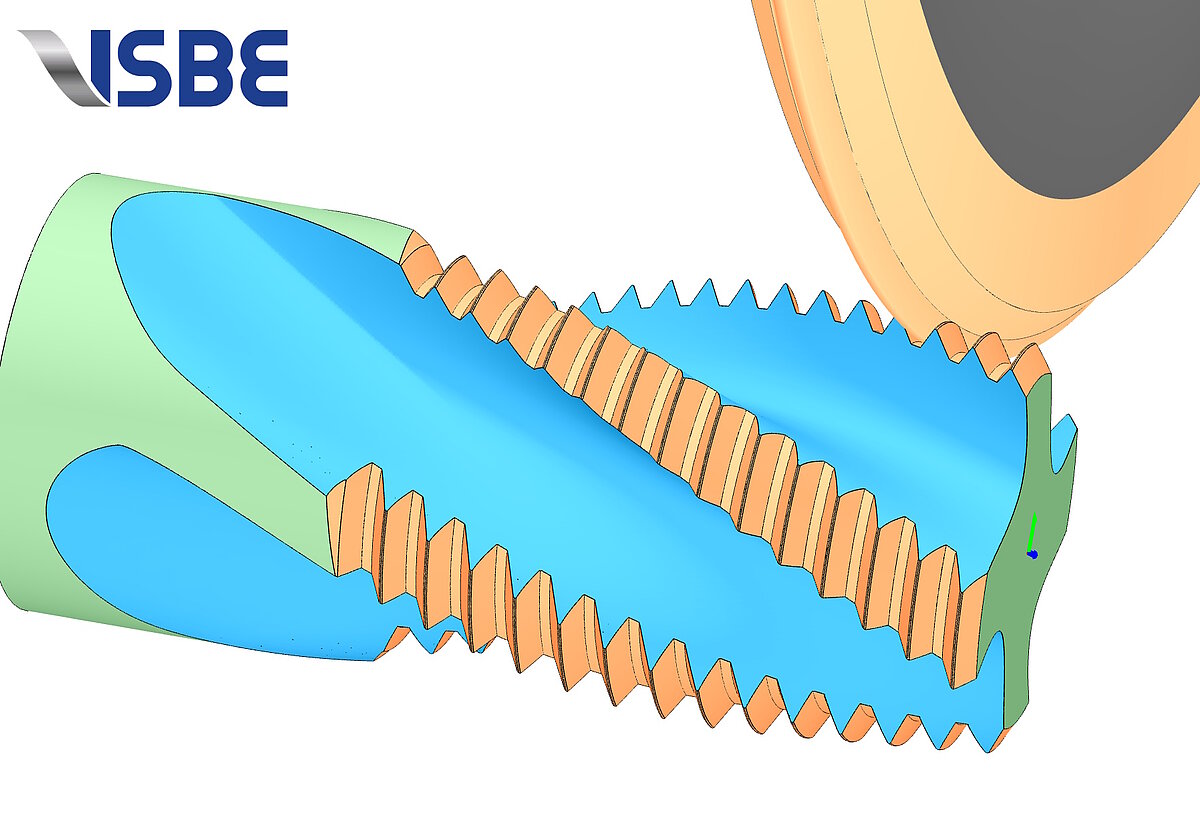
Thread milling cutter
By taking all relevant geometric relationships into account, even complex thread forms can be calculated with precision. In addition to classic standard thread profiles, this includes special geometries or customised designs, which can be imported via DXF data, for example. The software automatically compensates for geometric distortions that may arise during the grinding process.
A particular advantage lies in the direct visualisation: the calculated geometries can be displayed in both 2D and 3D and exported as a surface model. This allows tool shapes to be checked as early as the design phase and subsequently used directly for production. At the same time, a clear and traceable data basis is created for manufacturing.
For tool manufacturers, this means significantly greater process reliability in the design of threading tools. Complex geometries are calculated in a reproducible manner, manufacturing parameters remain transparently traceable, and adjustments can be implemented quickly and in a controlled manner.
Partnership rather than a software project
What sets ISBE apart is its partnership-based approach. The collaboration does not end with the commissioning of a software solution. Rather, the software products and systems are further developed in collaboration with customers – in line with real-world manufacturing requirements. Changes to the product portfolio, new customer requirements or organisational adjustments can thus be implemented step-by-step and in a controlled manner.
For all companies in the tool manufacturing sector, this means investment security, predictable digitalisation steps and a partner who understands industrial contexts – both technically and economically.
Conclusion
Digital solutions only realise their full potential when they are consistently aligned with the realities of tool manufacturing. ISBE GmbH embodies precisely this approach: software that understands context, accommodates variations and makes industrial rules explicit. As a reliable partner, ISBE supports its customers in making their processes transparent, stable and future-proof.
Source | ISBE