
Chip-forming tools specifically designed for grooving and grooving turning
A small detail, a big impact
In machining, a single detail often determines whether the process is reliable or results in scrap: the chip breaker. This makes it far more than just an accessory to the cutting edge—it is an integral part of the tool. Which of the many different chip breakers is the right one depends on the material, cutting parameters, process, and machine.
Chip formers are the geometric features on the cutting surface of the insert that precisely control chip formation, chip flow, and chip breaking. Their function sounds simple, but it is actually quite challenging. The chip former must redirect and shape the chip so that it curls cleanly, breaks as short as possible, and is reliably removed from the cutting zone without being crushed, snagged, or flung back onto the workpiece surface. If this fails, scratches and grooves form on the surface, and users have to contend with increased wear, damage to the cutting edges, and machine downtime.
“When a long chip wraps around the tool and brings the machine to a standstill, it’s not only annoying but also a real problem, especially during grooving,” says Frederik Schmalbach, Product Manager for Non-Rotating Tools at ISCAR. “Chip evacuation is a key factor here for process reliability, tool life, and surface quality.”
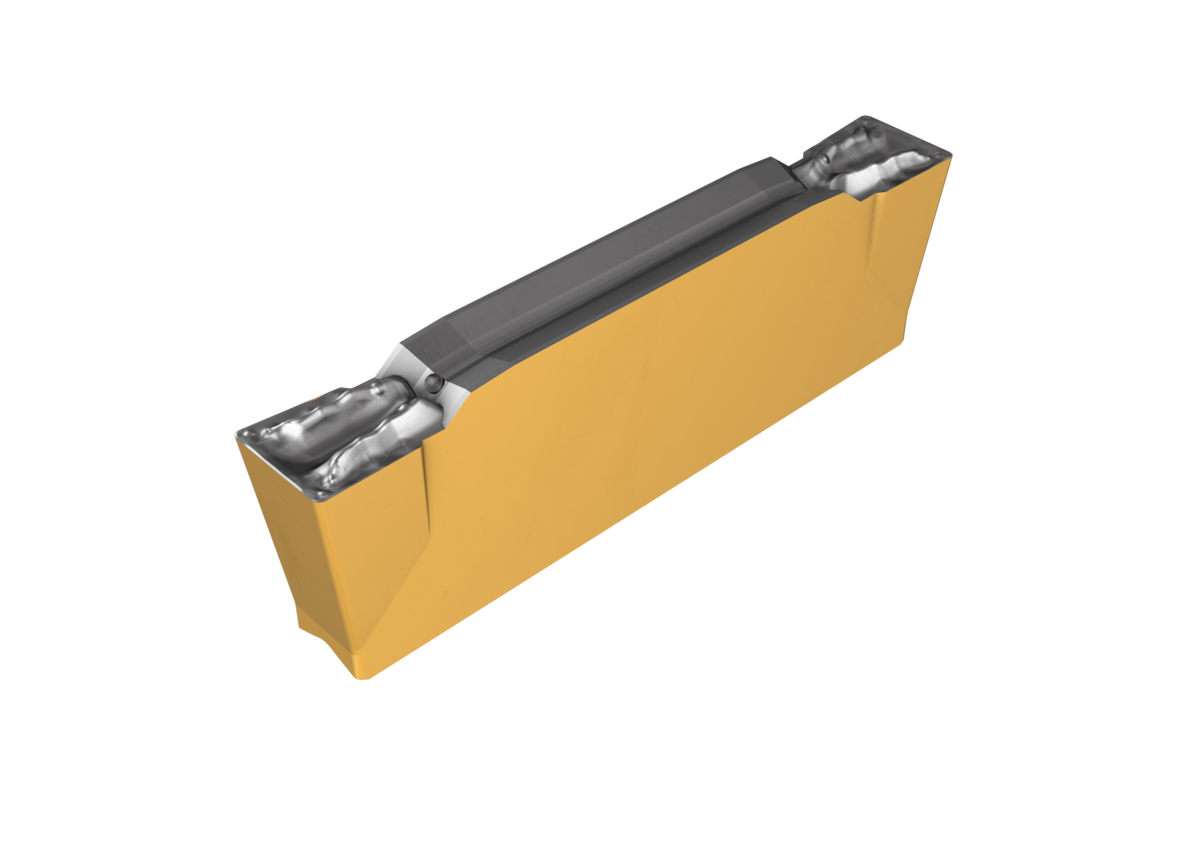
The T-Spanformer features a positive chip groove, a stable cutting edge, and a chip deflector
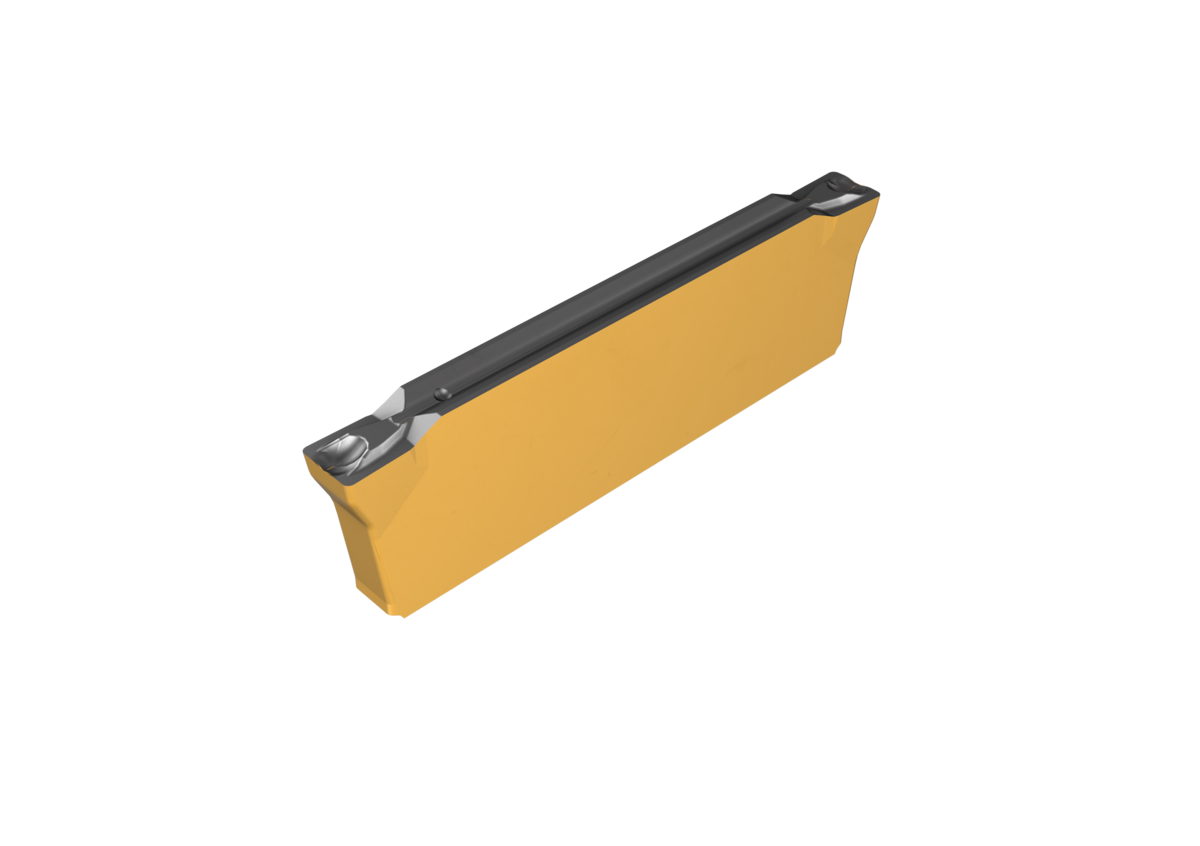
The new B-Spanformer offers the right geometry for machining particularly tough materials with DO-GRIP, TANG-GRIP, and PENTACUT cutting inserts
Factors for the Perfect Chip
Chip formers can be classified based on their operating principle, geometry, and field of application. Geometric chip formers are directly integrated into the rake face of the cutting insert. Typical examples include chip grooves, chip-breaking steps, nose shapes, and profiled chip pockets. They mechanically influence how the chip deforms, curls, and breaks.
Material-specific chip formers are tailored to typical material properties. A chip former for ISO-P steels is designed differently than one for ISO-M stainless steels or ISO-S high-temperature alloys. Chip formation, cutting forces, and friction behavior vary considerably depending on the material group.
Process-specific chip formers take the respective machining application into account. External grooving, internal grooving, parting off, and slot grooving place different demands on the chip former. “In practice, however, these three categories are rarely strictly separated,” says Frederik Schmalbach. “Modern chip formers combine all three aspects into a geometry that is specifically tailored to a tool system, a workpiece group, and a machining application.”
To be able to offer users the right chipbreaker for every grooving task, ISCAR has consistently expanded its portfolio in recent years. “Some of these are truly new developments that have made their way from the custom sector into the standard lineup; others are existing geometries that we’ve been able to adapt from other fields for grooving,” says Frederik Schmalbach.
When searching for a chipformer, ISCAR supports users not only with personalized consultation but also with its “Chipformer Guide,” which can be requested from the responsible consultant.
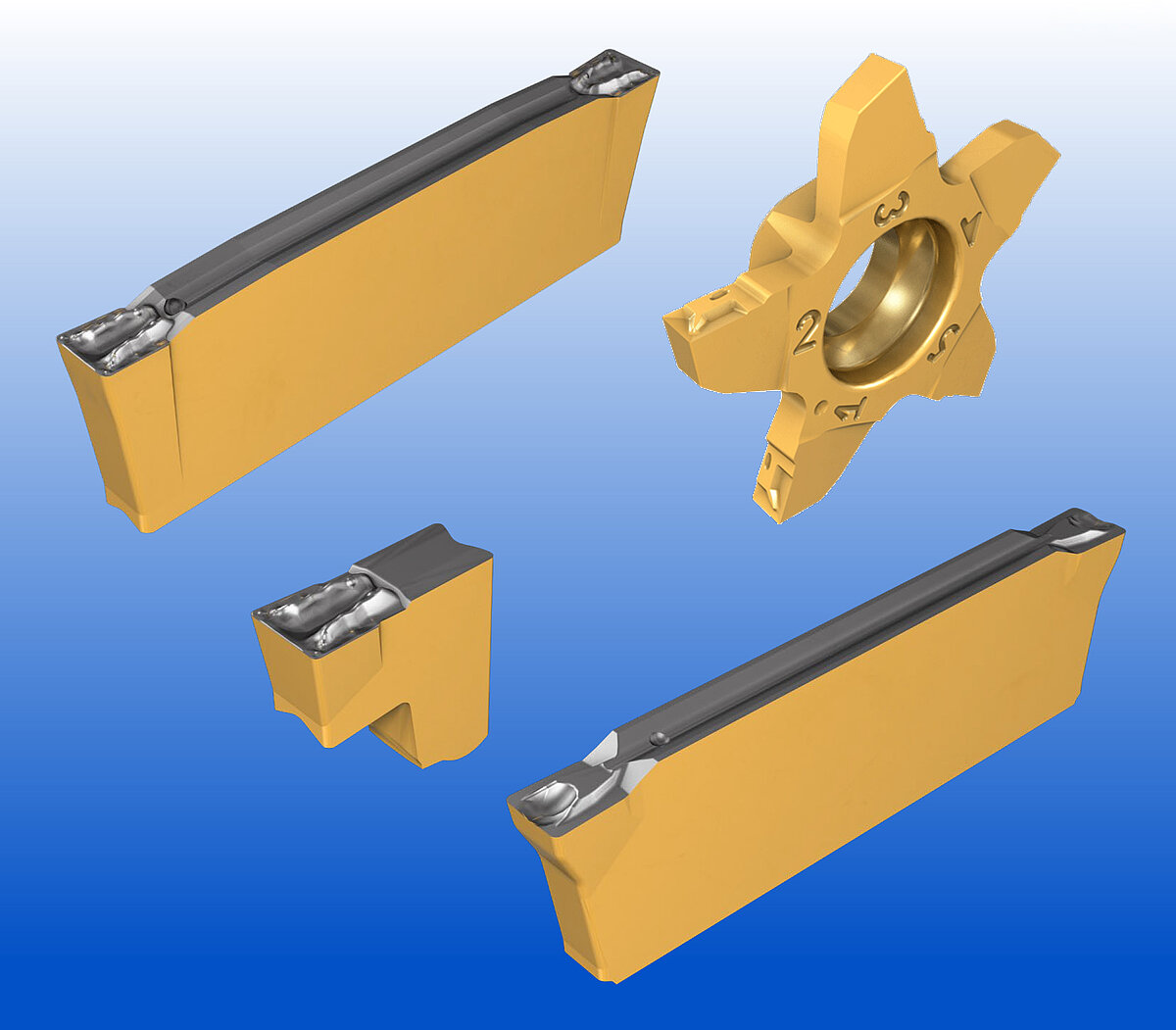
In order to provide users with the right chipbreaker for every cutting application, ISCAR has consistently expanded its product portfolio in recent years
A Wide Range of Applications
In turning operations, chip removal is generally straightforward. The chip has room to move and can simply flow away to the side. In grooving and parting-off operations, on the other hand, the tool penetrates the workpiece radially. “The deeper the cut, the narrower the groove,” explains the product manager. “So the chip has hardly any room and must behave in a controlled manner from the very first moment.”
Tough materials such as low-alloy steels, stainless steels, and wrought alloys form long, ribbon-like chips that do not break without a chip former. The chip former rolls the chip tightly and breaks it early. The result: unobstructed chip evacuation, stable cutting conditions, and uniform wear.
“Chip formers are always used when the material being machined tends to produce long, tough chips, when tight grooving widths or deep grooves are being machined, when automated processes with long runtime are required, and when experience has shown that chip wrapping and chip jamming become problems,” Frederik Schmalbach lists. “Furthermore, wherever surface quality and dimensional accuracy do not tolerate any deviations, the appropriate chipformer geometry is not an optional detail.”
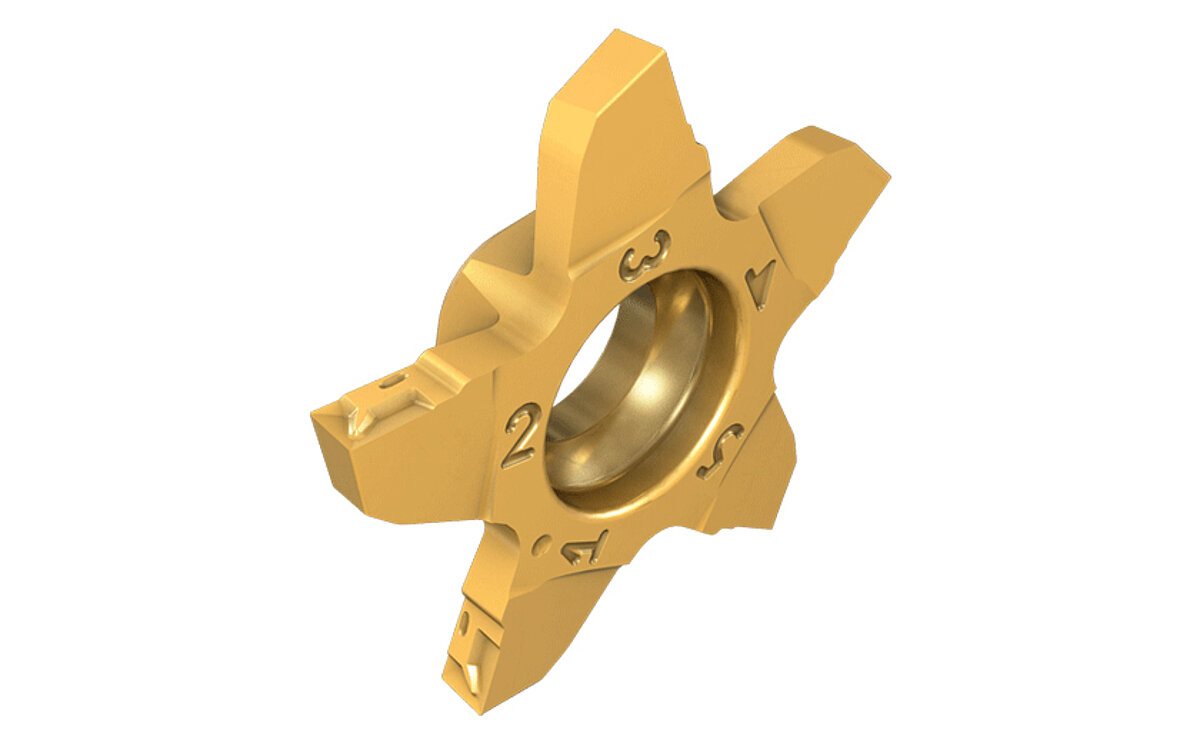
The new NX chip former breaks the chips into short pieces and gives the user precise chip control when machining small parts
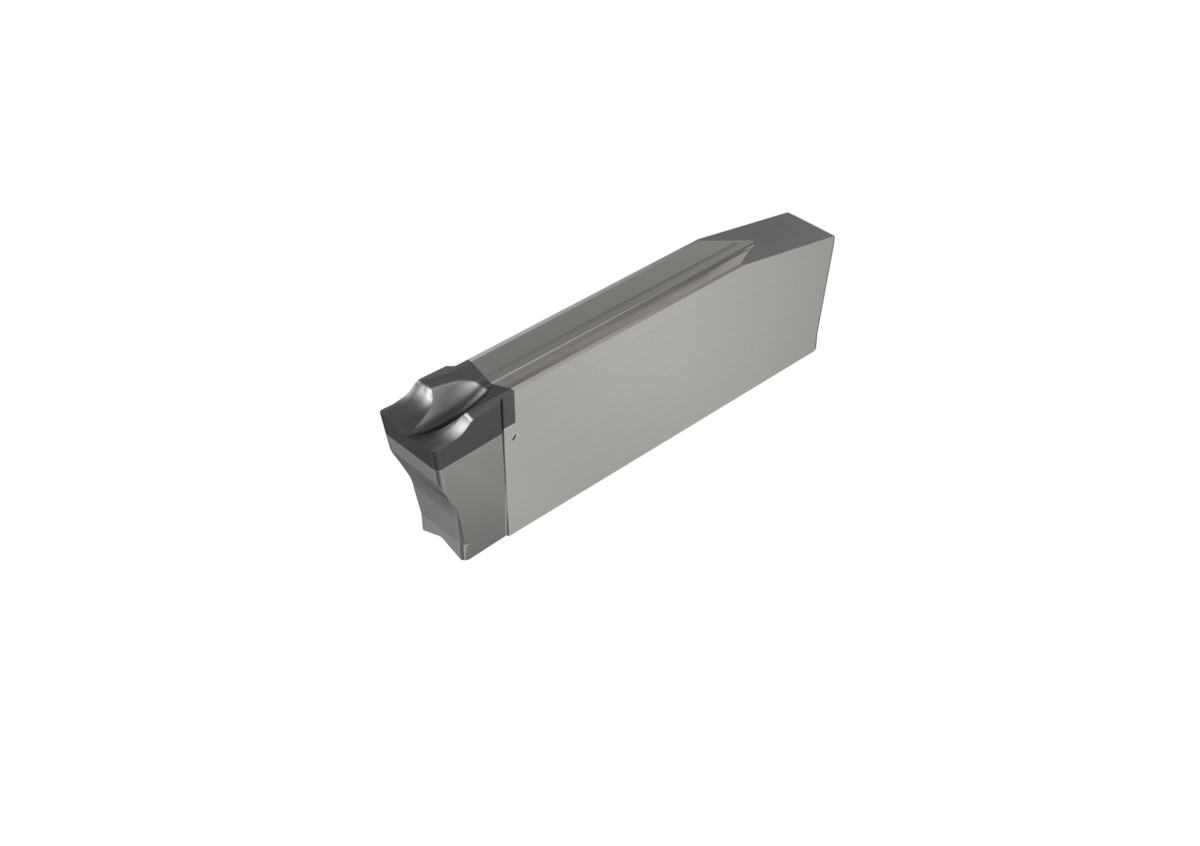
PKD cutting inserts with the J-chip former for the DO-GRIP system for machining non-ferrous metals
The T-Chipformer: The Top Choice for Chip Control
The T-Chipformer has its roots in grooving and has proven itself on the cutting edges of the CUT-GRIP series. “It cuts through metal as if it were cotton,” says Frederik Schmalbach enthusiastically. “We simply had to adapt it for our DO-GRIP and TANG-GRIP cutting inserts.” The T-Chip Former features a positive chip groove, a stable cutting edge, and a chip deflector. This deflector is positioned close to the cutting edge and the corner radius, enabling superior chip control. The chip is rolled up in a controlled manner and breaks off reliably at a short length.
The stable cutting edge of the T-Chip Former also allows for the partial widening of grooves—that is, lateral grooving after the initial cut. Thus, the geometry covers two typical machining scenarios.
When searching for cutting tools, ISCAR also supports users with its “Cutting Tool Guide,” which can be requested from the appropriate consultant
B Chip Former: For Tough Materials and When Build-Up Edge Forms
The new B-Chip Former offers the ideal geometry for machining particularly tough materials with DO-GRIP, TANG-GRIP, and PENTACUT inserts. Its chip deflector, which extends far upward, guides the chip over a longer distance and rolls it up tightly. The sharp cutting edge transitions into a smooth-cutting chip groove, preventing vibrations. To prevent chip entanglement when machining very tough materials, the B-Chip Former also effectively constricts the chip laterally. “The B-Chip Former is our solution for materials that pose problems for conventional geometries, such as 100Cr6 or similarly tough bearing steels. Without a suitable chip former, built-up edges and uncontrolled chip ejection quickly occur in these applications,” says Frederik Schmalbach.

“Choosing the right chipformer for a given task isn't a matter of chance, but rather depends on clear technical criteria. Once you understand this, you gain a real advantage in terms of greater process reliability, longer tool life, and better surface finishes,” sums up Frederik Schmalbach, Product Manager for Non-Rotating Tools at ISCAR.
NX Chipformer for PENTA 17: For Short Chips
The PENTA 17 is ISCAR’s system for small parts. Until now, the five-edge insert was equipped only with grooves. These produced very long chips that could wrap around the tool and workpiece. To overcome this challenge, ISCAR has developed the NX Chip Former. Its geometry features a sharp cutting edge that transitions into a soft-cutting chip groove. “With the new NX Chip Former, chips break short, and we provide the user with precise chip control when machining small parts,” says the product manager.
J-Chipformer on PCD: High Performance for Non-Ferrous Metals
The latest addition to ISCAR’s chipformer lineup for grooving is also the most technically sophisticated: PCD cutting inserts with the J-Chipformer for the DO-GRIP system, designed for machining non-ferrous metals. “PCD and the J-Chipformer are a logical combination. PCD provides the sharpness and wear resistance, while the J-Chipformer ensures that the chip is removed in a controlled manner despite high cutting speeds,” says Frederik Schmalbach.
The laser-etched J-Chipformer shapes the chip with precision and reproducibility. It can be used to machine aluminum and copper alloys, brass, non-metals, and fiber-reinforced composites.
“Selecting the right chip former for a task isn’t a matter of chance, but rather follows clear technical criteria,” Frederik Schmalbach sums it up. “Once you understand that, you gain a real advantage for greater process reliability, longer tool life, and better surface finishes.”
Source | ISCAR